resource
Year 8 Catholic RE Talk: Dialogue and Encounter | 7 Structured Discussions + Scaffolds + SEND
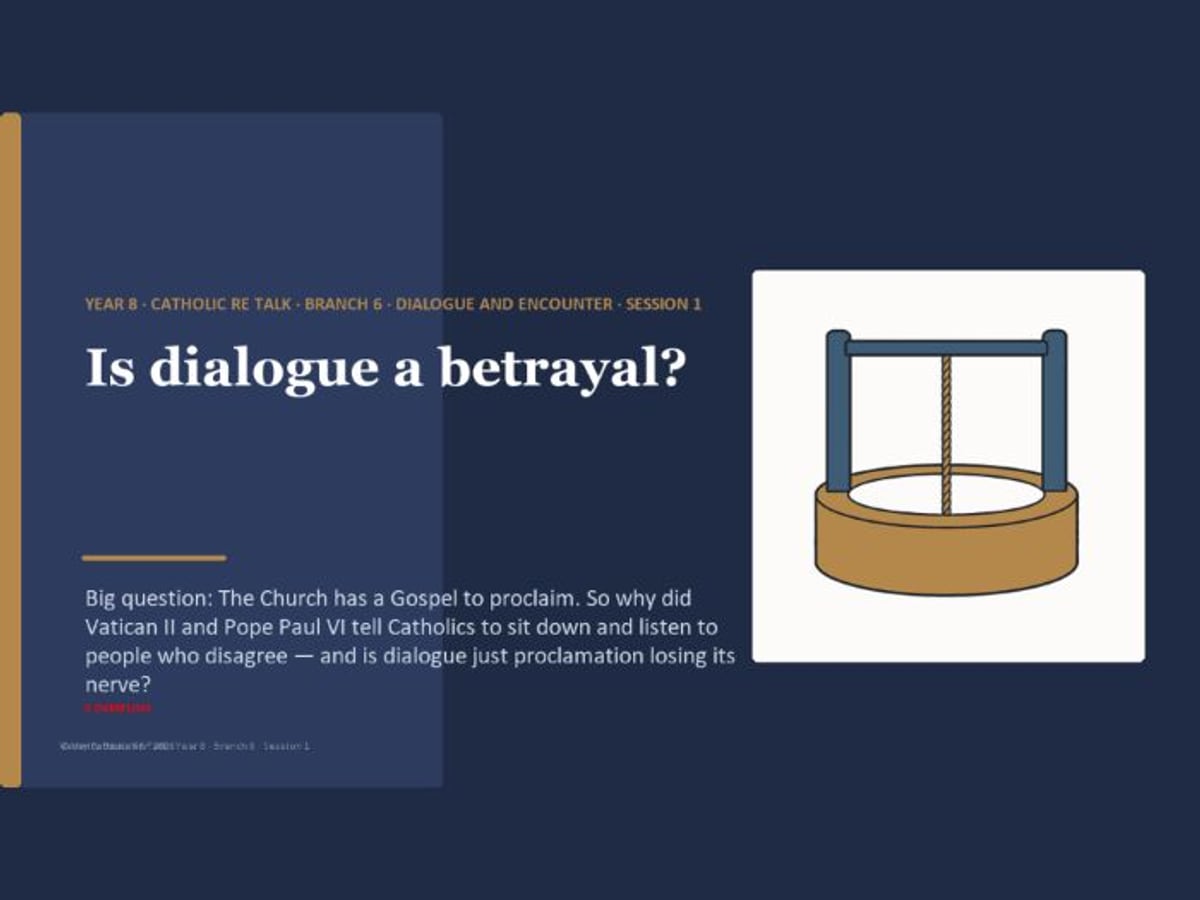
Seven structured discussions that turn the Year 8 RED branch 'Dialogue and Encounter' into spoken theology — with scaffolds for every pupil and SEND built in. Oracy and Catholic RE belong together: the Directory's Ways of Knowing, Discern and Respond, are things pupils do out loud. Each session takes the key learning of one lesson in the branch and makes pupils reason about it: a genuine theological question, a named talk protocol, three tiers of scaffold (Launch, Build, Stretch), an Objection-and-Reply stretch in the pattern of St Thomas Aquinas, a scholar's voice, and a sixty-second spoken answer that becomes a written one. Rigorous: every session cites the Catechism by paragraph, names the heresy or the council, and asks pupils to answer the strongest objection, not the weakest. Scaffolded: sentence stems, talk roles, rehearsal time and visual prompts sit on every Talk Mat, so no pupil is singled out. THE SEVEN SESSIONS 1. Is dialogue a betrayal? — The Church has a Gospel to proclaim. Why did Vatican II and Paul VI tell Catholics to listen to people who disagree — is dialogue just proclamation losing its nerve? (Think, Pair, Square) 2. Who is inside the circle? — Paul VI drew the Church's dialogue as four circles, with all humanity on the outer ring. If everyone is inside the circle, is every belief as good as every other? (Build, Challenge, Clarify) 3. Is the Catholic Church more than Roman? — Married priests, icons not statues, babies receiving Communion: all fully Catholic. If the Eastern Catholic Churches are that different, what makes them one Church with Rome? (Hot Seat the Expert) 4. Can a Catholic learn from the Buddha? — A prince left his palace to learn why people suffer and returned with four truths. Can a Catholic learn anything from a religion with no creator God? (Community of Enquiry) 5. Can you save yourself? — The Buddha gave his followers a path and said: walk it. Is a religion where you do the work yourself more honest, or less hopeful, than salvation by grace? (Talk Detectives) 6. If nothing lasts, why be kind? — Buddhists teach that everything changes and nothing lasts, not even the self. So why do Buddhists spend their lives practising compassion — and what does a Catholic make of it? (Where Do You Stand?) 7. Can we live together without pretending? — A Catholic and a Buddhist disagree about God, the soul and what happens at death. Can they be real friends and build a neighbourhood together without pretending they agree? (Fishbowl) WHAT YOU GET • 7 student-facing session decks (14 slides each, illustrated, 20-point body text): Today, Warm up, Hear, Words, Big question, Protocol, Scaffold tiers, Objection, On the contrary & reply, Scholar's corner, Respond, Reflect. • Teacher Guide: session plans, subject knowledge, model answers for every objection, misconceptions, timings for three delivery modes, SEND and challenge notes. • Student Talk Pack: a two-page Talk Mat per session — question, three-tier stems, vocabulary with pronunciation, roles, Objection & Reply planner, Say-it-then-write-it frame, listening tracker. • Talk Knowledge Organiser: the branch's disciplinary vocabulary, the five talk moves, the Aquinas pattern, key references. • Oracy & Discernment Assessment Pack: four-strand oracy rubric, the end-of-branch two-minute Speaking Assessment with mark scheme and model answer, and the Pupil Oracy Log. • SEND & Access Booklet: access notes per session, communication-needs adaptations, pre-teaching cards, simplified visual talk cards and Engagement Model planning for pupils with EHC plans. HOW TO RUN IT As a 15–20 minute Talk Slot inside the matching RE lesson; as a full 50–60 minute Talk Lesson; or as the spoken assessment of the branch. No oracy training needed: every protocol is scripted with a model. Complements the Year 8 Verity Catholic RE units and works alongside any RED-aligned scheme. Fully editable. Single-school licence. Aligned to To Know You More Clearly: The Religious Education Directory for Catholic Schools, Colleges and Academies in England and Wales (© Catholic Bishops' Conference of England and Wales, 2023; published by the Catholic Education Service). An independent teaching resource written to support the Directory's branches and outcomes; it does not reproduce the Directory's text and is not an official or approved edition. Not affiliated with, endorsed by, approved by or produced by the Catholic Education Service, the Catholic Bishops' Conference of England and Wales or any diocese. Oracy approach informed by the Oracy Skills Framework (Voice 21 and Oracy Cambridge, University of Cambridge, 2018), an openly published framework; referenced, not reproduced. Catechism references are by paragraph number; Scripture is cited by reference. Illustrations are original to Verity Education and were produced using generative AI tools. © Verity Education 2026. Licensed for use within the purchasing school.
£8.00
You'll get instant access after payment. This ends your 14-day cancellation right once you download or open it — see our Refund Policy.
Preview this scheme
Not sure yet? Download a complete, full-quality free sample lesson from this subject first — no card needed.
Year 8 Catholic RE Free Sample Lesson: The Miracles of Jesus