resource
Year 9 Catholic RE Talk: Dialogue and Encounter | 7 Structured Discussions + Scaffolds + SEND
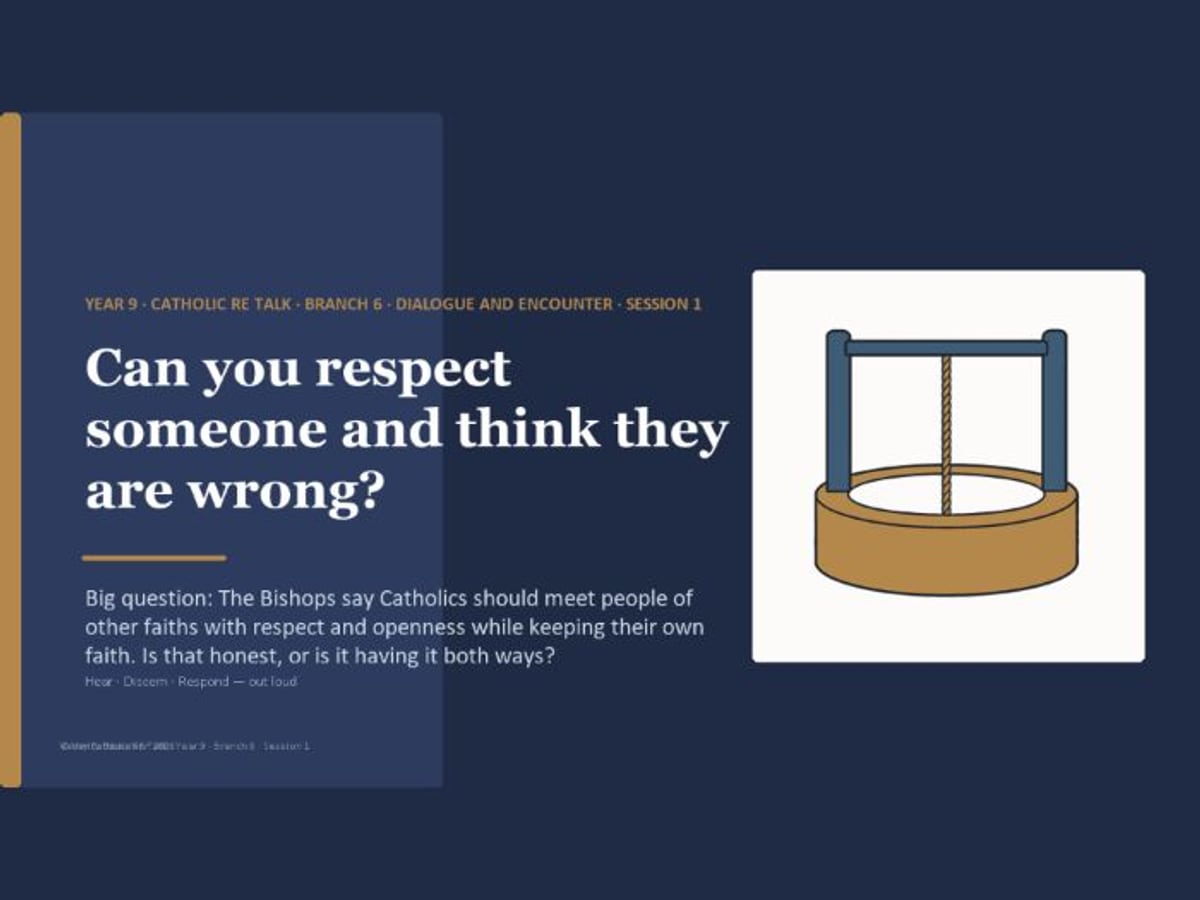
Seven structured discussions that turn the Year 9 RED branch 'Dialogue and Encounter' into spoken theology — with scaffolds for every pupil and SEND built in. Oracy and Catholic RE belong together: the Directory's Ways of Knowing, Discern and Respond, are things pupils do out loud. Each session takes the key learning of one lesson in the branch and makes pupils reason about it: a genuine theological question, a named talk protocol, three tiers of scaffold (Launch, Build, Stretch), an Objection-and-Reply stretch in the pattern of St Thomas Aquinas, a scholar's voice, and a sixty-second spoken answer that becomes a written one. Rigorous: every session cites the Catechism by paragraph, names the heresy or the council, and asks pupils to answer the strongest objection, not the weakest. Scaffolded: sentence stems, talk roles, rehearsal time and visual prompts sit on every Talk Mat, so no pupil is singled out. THE SEVEN SESSIONS 1. Can you respect someone and think they are wrong? — The Bishops say Catholics should meet people of other faiths with respect and openness while keeping their own faith. Is that honest, or is it having it both ways? (Think, Pair, Square) 2. Who is my neighbour, really? — A lawyer asked Jesus 'Who is my neighbour?' and got a Samaritan. If everyone is my neighbour, is anyone — and what does 'the common good' actually commit me to? (Where Do You Stand?) 3. One God or many? — Hindus speak of one Brahman and worship God in many forms. What are Hindus actually saying — and what can a Catholic honestly learn from it? (Community of Enquiry) 4. Do you get what you deserve? — Karma says actions have consequences across lives; moksha is release from the cycle. Is that the same as Christian judgement with extra lives — and is it fair? (Build, Challenge, Clarify) 5. Is it an idol or an icon? — Hindus offer puja before a murti; Catholics light candles before a statue. Is bowing to an image always idolatry — and what does each tradition say it is doing? (Hot Seat the Expert) 6. Would you stop eating meat for a belief? — Many Hindus are vegetarian because of ahimsa, non-violence to all life. Is that a belief shaping a life, or common decency with a Sanskrit name? (Talk Detectives) 7. Do you only believe because of your upbringing? — Born in Varanasi, you would probably be Hindu. Does that mean no belief is truer than another and dialogue is just tolerance — or something else? (Fishbowl) WHAT YOU GET • 7 student-facing session decks (14 slides each, illustrated, 20-point body text): Today, Warm up, Hear, Words, Big question, Protocol, Scaffold tiers, Objection, On the contrary & reply, Scholar's corner, Respond, Reflect. • Teacher Guide: session plans, subject knowledge, model answers for every objection, misconceptions, timings for three delivery modes, SEND and challenge notes. • Student Talk Pack: a two-page Talk Mat per session — question, three-tier stems, vocabulary with pronunciation, roles, Objection & Reply planner, Say-it-then-write-it frame, listening tracker. • Talk Knowledge Organiser: the branch's disciplinary vocabulary, the five talk moves, the Aquinas pattern, key references. • Oracy & Discernment Assessment Pack: four-strand oracy rubric, the end-of-branch two-minute Speaking Assessment with mark scheme and model answer, and the Pupil Oracy Log. • SEND & Access Booklet: access notes per session, communication-needs adaptations, pre-teaching cards, simplified visual talk cards and Engagement Model planning for pupils with EHC plans. HOW TO RUN IT As a 15–20 minute Talk Slot inside the matching RE lesson; as a full 50–60 minute Talk Lesson; or as the spoken assessment of the branch. No oracy training needed: every protocol is scripted with a model. Complements the Year 9 Verity Catholic RE units and works alongside any RED-aligned scheme. Fully editable. Single-school licence. Aligned to To Know You More Clearly: The Religious Education Directory for Catholic Schools, Colleges and Academies in England and Wales (© Catholic Bishops' Conference of England and Wales, 2023; published by the Catholic Education Service). An independent teaching resource written to support the Directory's branches and outcomes; it does not reproduce the Directory's text and is not an official or approved edition. Not affiliated with, endorsed by, approved by or produced by the Catholic Education Service, the Catholic Bishops' Conference of England and Wales or any diocese. Oracy approach informed by the Oracy Skills Framework (Voice 21 and Oracy Cambridge, University of Cambridge, 2018), an openly published framework; referenced, not reproduced. Catechism references are by paragraph number; Scripture is cited by reference. Illustrations are original to Verity Education and were produced using generative AI tools. © Verity Education 2026. Licensed for use within the purchasing school.
£8.00
You'll get instant access after payment. This ends your 14-day cancellation right once you download or open it — see our Refund Policy.
Preview this scheme
Not sure yet? Download a complete, full-quality free sample lesson from this subject first — no card needed.
Year 9 Catholic RE Free Sample Lesson: Imago Dei & Inalienable Dignity